

Three villages, one town hall
Călinești is the first commune in the Republic of Moldova formed by voluntary amalgamation. In 2025 the people of Călinești, Chetriș and Hîncești decided, by the vote of their local councils, to go on together — one commune, with its centre at Călinești.
For you this means one town hall for all three villages: here the commune’s budget is decided, and the projects carried out in your village. For documents and certificates you need not travel to Călinești — a CUPS desk works in your own village.
Read more about the amalgamationThe town hall in figures
A summary from the mayor's activity report for 2025.
The Călinești communal council
13 councillors, term 2025–2027, elected at the new local elections of 16 November 2025.
The communal council is the team of 13 councillors the inhabitants elected to decide on their behalf. The councillors decide how the commune's money is spent, what happens to its assets — land, buildings, roads — and how the services you use every day work, from kindergartens and libraries to waste collection and street lighting. Decisions are taken by vote, in meetings open to the public, under rules set by law and by the council's own rules of procedure.
It meets at least once every three months
And when something urgent comes up, the council can meet at any time — at the request of the mayor or of a third of the councillors.
You can follow the meetings
Council meetings are open to every citizen. The agenda is announced in advance on the town hall's website, on the notice board and on the official social media pages.
You can have your say before the vote
Draft decisions are published at least 15 working days before the council meeting. During that time citizens can read them and send proposals or opinions. Once adopted, the decisions stay public and can be consulted at any time.
Getting in touch with the councillors
You can contact the local councillors to put questions, suggestions or community problems to them. Official petitions addressed to the local council are examined and settled as the law provides.
Note: Petitions addressed to the local council are examined by the local public authority, under the legislation on petitions and on local public administration. An individual councillor does not, as a rule, carry the same legal duty to examine and answer petitions as the institution does.
Members of the council
- Raisa Pascari, Party of Action and Solidarity
- Oleg Morcov, Party of Action and Solidarity
- Eduard Curtescu, Party of Action and Solidarity
- Nina Budac, Party of Action and Solidarity
- Dionis Ghemu, Party of Action and Solidarity
- Alexandra Negoița, Party of Socialists of the Republic of Moldova
- Aliona Suvac, Party of Socialists of the Republic of Moldova
- Octavian Botnaru, Party of Socialists of the Republic of Moldova
- Ion Jornea, European Social Democratic Party
- Angela Hadîrca, European Social Democratic Party
- Gheorghe Magdîl, European Social Democratic Party
- Svetlana Pădure, Independent candidate
- Stella Pantea, Independent candidate
Specialist advisory committees
Budget and finance
- Gheorghe Magdîl
- Alexandra Negoița
- Svetlana Pădure
- Aliona Suvac
- Angela Hadîrca
Agriculture and the environment — Agriculture, ecology, environmental protection and spatial planning
- Eduard Curtescu
- Octavian Botnaru
- Ion Jornea
- Dionis Ghemu
- Oleg Morcov
Social affairs, education and health — Social and cultural activities, education, health, social protection, youth and sport
- Raisa Pascari
- Stella Pantea
- Nina Budac
How the council is formed and how it works, its standing committees, the voting procedure and the councillor’s mandate are set out in the council’s rules of procedure. The document is published under Transparency, in „Strategic and operational documents”, together with the commune’s statute and the other founding, strategic and operational documents.
The commune's mayor
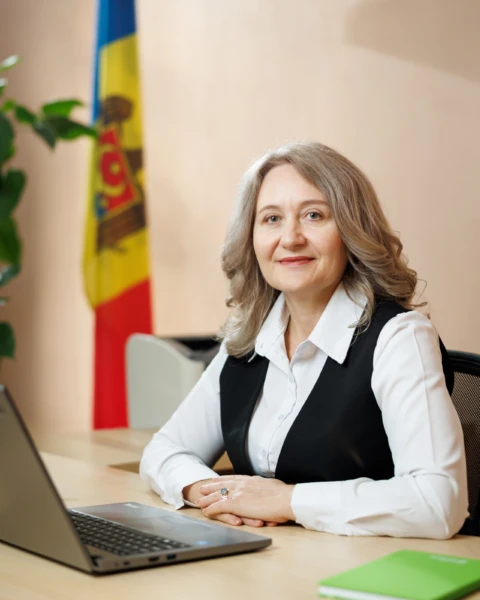
Ala Procopciuc
Mayor of Călinești commune
With a long career in public administration and accounting (chief accountant of the Călinești town hall between 1997 and 2021), Mrs Ala Procopciuc leads the local administration, promoting transparency and the participation of citizens in community life.
Download the CVMain responsibilities
- Leading the local public administration and coordinating the institutions and public services of the town hall
- Carrying out and monitoring the local development strategies and the infrastructure projects
- Managing the local budget and coordinating spending on programmes of community interest
- Working with district and central authorities to attract funding and carry out national and European programmes
- Organising educational, social and cultural activities within the community
- Representing the community in its dealings with institutions, non-governmental organisations and other public authorities
- Managing relations with citizens and promoting public participation in local decision-making
Education: The State Agrarian University of Moldova, Faculty of Economics.
Structure and organisation chart
The town hall’s staff numbers 26.5 posts, in three categories:
- Civil servants — they apply the law and issue the documents: tax, land and cadastre, legal, human resources, budget planning and procurement.
- Specialist staff — accounting, attracting investment and projects, and the specialists at the CUPS desks.
- Technical and auxiliary staff — they keep the building running day to day: archive, transport, maintenance, security.
Apart from the town hall’s own staff, the commune runs 10 subordinate institutions — four kindergartens, three public libraries, the house of culture in Călinești, the cultural centre in Hîncești and the volunteer fire station. Their contacts are on the Contacts page.
The figures are approved posts, not people employed (0.5 = half time). The structure is approved by decision of the local council — the decisions in force can be consulted in the Register of local acts.
- Chief accountant 1
- Principal specialist — tax 2
- Principal specialist — land 2
- Principal specialist — legal 1
- Principal specialist — human resources 1
- Principal specialist — budget planning and procurement 1
- Accountant 1
- Principal specialist — attracting investment and projects 1
- Principal specialist — Unified Public Service Centre (CUPS) 3
- Archivist 0.5
- Driver 1
- Security guard 5.5
- Cleaner 1
- Electrician 1
- Boiler operator 0.5
- Grounds keeper 1
- Courier 1
- Călinești public library
- Chetriș public library
- Hîncești public library
- Călinești house of culture
- Hîncești cultural centre
- „Albinuța” kindergarten, Hîncești
- Chetriș kindergarten
- Kindergarten no. 1 Călinești
- Kindergarten no. 2 Călinești
- Volunteer fire station
The town hall staff
- Ala Procopciuc, Mayor
- Elena Ivanov, Secretary of the communal council
- Natalia Dogotari, Chief accountant
- Alexandrina Bernevic, Principal specialist — tax
- Rodica Sacicov, Principal specialist — tax
- Artur Șontea, Principal specialist — land
- Ala Sacicov, Principal specialist — land
- Mihaela Chiriac, Principal specialist — legal
- Raisa Ghemu, Principal specialist — human resources
- Raisa Ilinițcaia, Accountant
- Parascovia Pădurari, Principal specialist — attracting investment and projects
- Mihaela Budac, Principal specialist — Unified Public Service Centre (CUPS)
- Elena Teșcureanu, Principal specialist — Unified Public Service Centre (CUPS)
- Angela Grîu, Principal specialist — Unified Public Service Centre (CUPS)
- Tatiana Țurcanu, Archivist
- Iurie Șolari, Driver
- Serghei Bobătrîn, Security guard
- Oleg Dubițchi, Security guard
- Tatiana Păduraru, Cleaner, production and service rooms
- Vitalie Gherman, Electrician
- Zinaida Grecu, Courier / cleaner / boiler operator
- Janna Balan, Courier / cleaner / boiler operator
- Ion Grecu, Grounds keeper